

GC Light Achieves Watt-Class Continuous-Wave Output from a 940 nm PCSEL Chip
GC Light has recently achieved a major breakthrough in 940 nm photonic crystal surface-emitting laser (PCSEL) development, demonstrating more than 1 W of room-temperature continuous-wave (CW) output power.
As a new type of semiconductor laser, the PCSEL exploits the two-dimensional resonance characteristics of a photonic crystal. Compared with conventional ridge-waveguide lasers or vertical-cavity surface-emitting lasers (VCSELs), it can support a much larger single-mode resonant aperture and higher single-mode output power. When the single-mode modal area extends to hundreds of micrometers or even the millimeter scale, the far-field divergence angle can be as low as 1° or even on the order of 0.1°. By contrast, conventional VCSELs and edge-emitting lasers typically exhibit far-field divergence angles greater than 10°, and the beam profile of edge emitters is often non-circular. In practical use, multiple lenses are therefore required for collimation, which increases system size and cost while also reducing reliability.
Using its proprietary photonic-crystal structure together with an efficient thermal-management package, the GC Light team successfully achieved watt-class continuous-wave output at room temperature in the 940 nm band. The device exhibits a far-field divergence angle below 1°, and under 10 °C temperature control, the output power can reach 1.6 W. Its wavelength temperature coefficient is about 0.09 nm/K, far lower than that of edge-emitting lasers and comparable to that of VCSELs, while also offering superior far-field divergence and a narrower spectral linewidth.
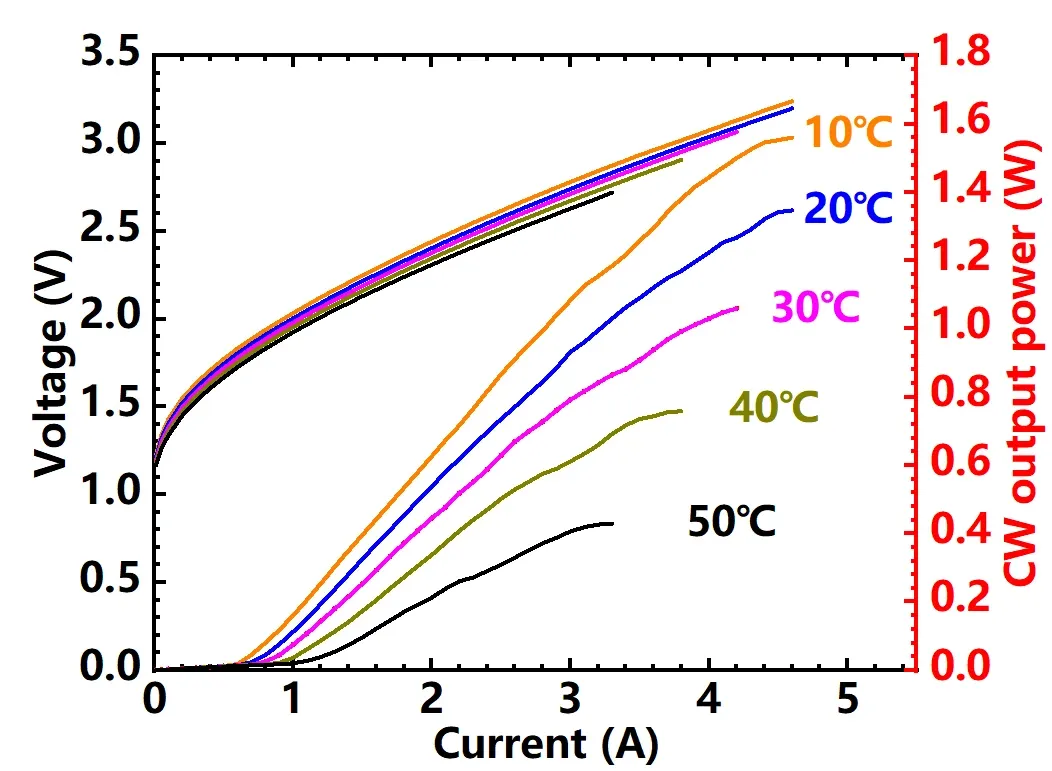
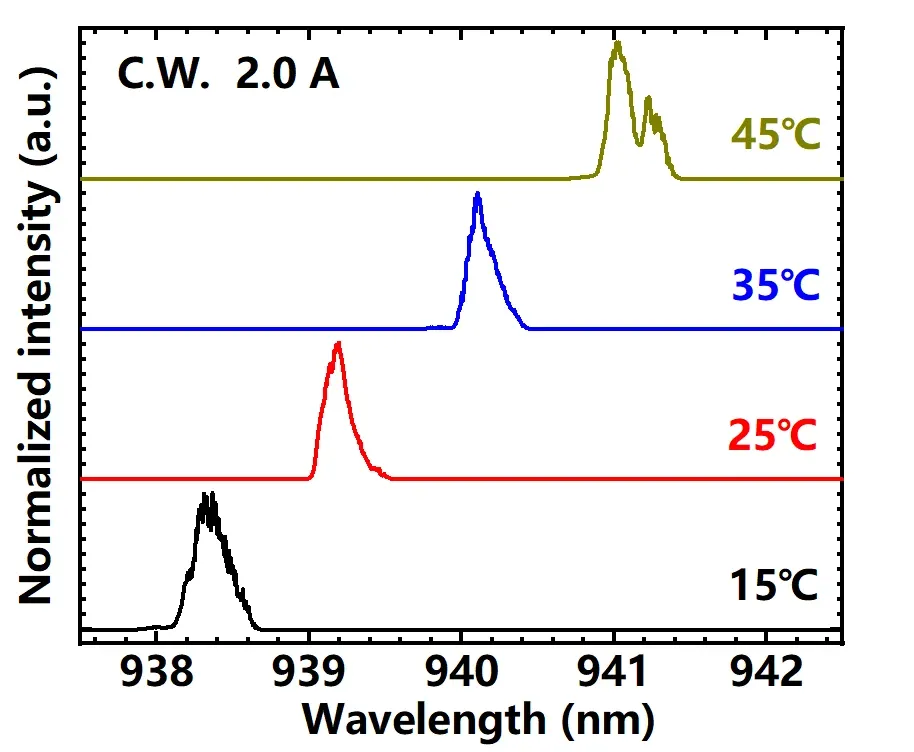
Device characteristics under continuous-wave operation
As a frontier technology, the PCSEL has been regarded as one of the key routes toward all-solid-state light sources for future LiDAR and related fields. The 940 nm band is especially promising because it is built on the lower-cost and more mature GaAs process platform. It offers broad application prospects in automotive LiDAR, industrial LiDAR, and related scenarios, and is expected to be among the first to achieve large-scale deployment. GC Light will continue advancing its R&D iterations to bring higher-performance PCSEL lasers into volume production.
Need full specs and pricing?
Contact our engineering team for datasheets and application support.
GC Light Completes Pre-A Financing Round
GC Light raises tens of millions of RMB from Shanghai Sci-Tech Innovation Fund, CASSTAR, and Zhongying Venture Capital to accelerate semiconductor laser R&D and PCSEL commercialization.
GC Light Achieves 200 mW Room-Temperature CW Output from a 1.3 μm Quantum-Dot PCSEL
GC Light has raised the room-temperature CW output power of its reported 1.3 μm InAs/GaAs quantum-dot PCSEL to 200 mW, setting a new benchmark among comparable 1.3 μm devices.