
What Is PCSEL: The Next-Generation High-Performance Semiconductor Laser
A long-standing challenge in the laser industry is the trade-off between compact semiconductor lasers and high-brightness light sources. Semiconductor lasers are efficient and small but suffer from limited single-mode power and larger far-field divergence, resulting in low brightness. Gas and solid-state lasers can achieve higher brightness, but with bulky systems and lower electro-optical efficiency. As applications demand greater miniaturization and integration, this conflict becomes more pronounced. The rapid development of photonic crystal surface-emitting lasers (PCSELs) offers a compelling solution by fundamentally reshaping the cavity structure of semiconductor lasers and dramatically lifting the brightness ceiling.
1. Operating Principle: Coherent Oscillation in a 2D Plane
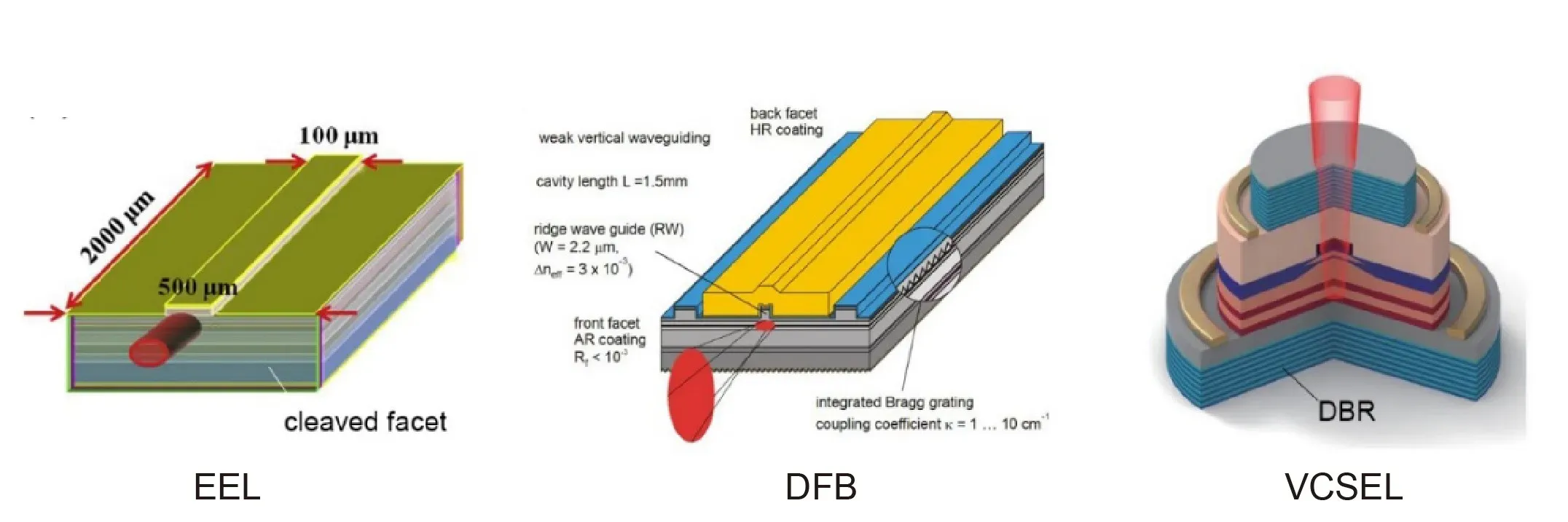
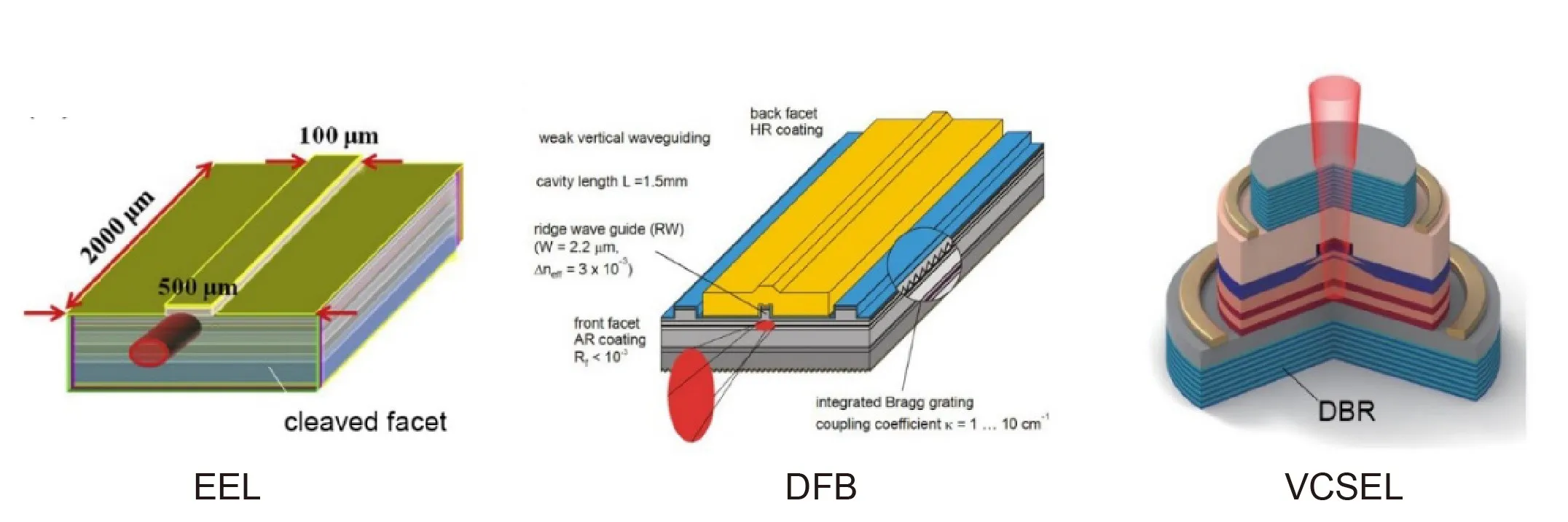
Conventional semiconductor lasers
The key to PCSELs lies in their unique photonic crystal resonator. Unlike edge-emitting lasers (Fabry–Pérot or 1D grating feedback) and VCSELs (vertical DBR feedback), PCSELs use a thin photonic crystal layer etched with a periodic array of nanoholes.
The optical field is confined to in-plane propagation and is concentrated within the photonic crystal layer (resonance) and the active region (gain). As waves propagate in different in-plane directions, the air holes couple these waves like micro diffraction centers, forming a large-area two-dimensional standing wave. This provides the physical basis for a large cavity and single-mode operation. From a band-structure perspective, band-edge states with near-zero group velocity yield a high density of optical states, enabling high-Q resonances. By selecting the lattice constant, devices can operate at the Γ2 band-edge mode, which offers optimal surface emission.
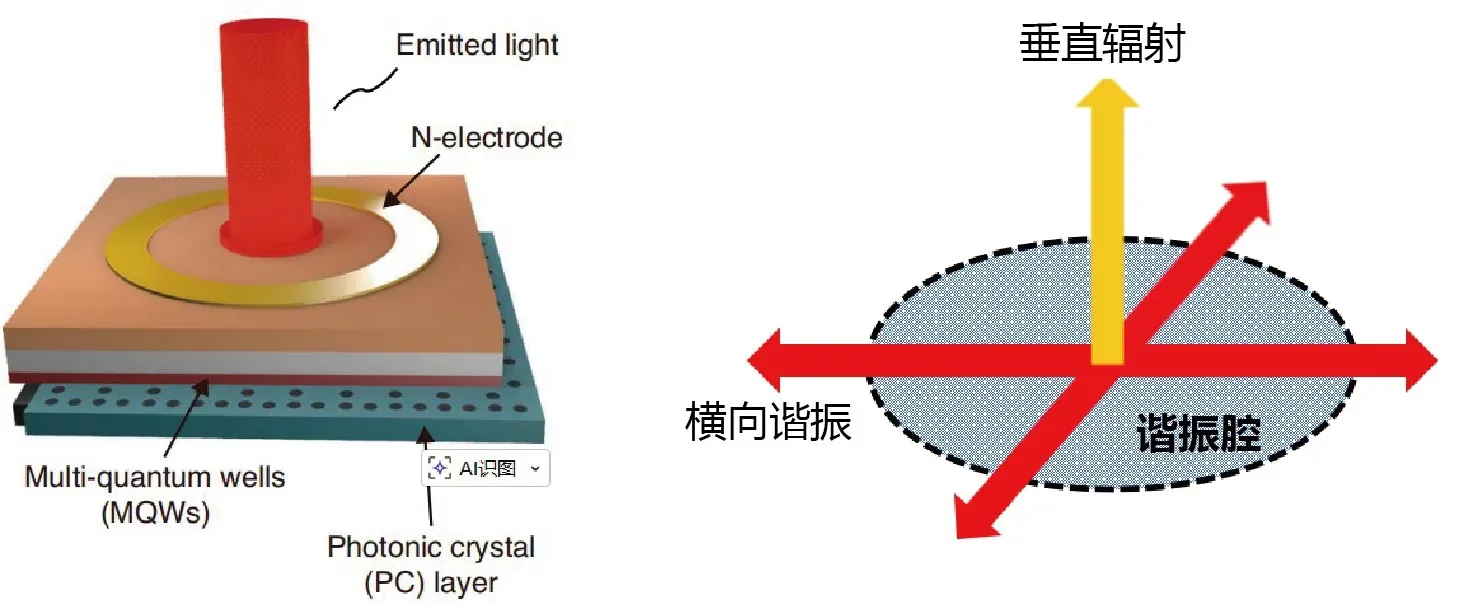
PCSEL device structure
Mode selectivity is strongly influenced by photonic crystal hole geometry. Suppressing higher-order modes and stabilizing the fundamental mode is essential for high beam quality. Mainstream structures include circular and triangular single-lattice designs, Kyoto University’s double-lattice structure, and our proposed triple-lattice and T-shaped designs. The core strategy is to increase diffraction loss for higher-order modes and achieve precise fabrication that matches design intent.
2. Performance Advantages: Multi-Dimensional Breakthroughs
PCSELs retain the low cost, compact size, and high efficiency of semiconductor lasers while delivering superior brightness and narrow linewidth, addressing key pain points in advanced laser applications.
Brightness Leap
Brightness is a critical metric for laser processing and long-range sensing. Conventional high-power semiconductor lasers typically deliver brightness below 0.1 GW·cm−2·sr−1, while PCSELs achieve an order-of-magnitude improvement. Under continuous-wave operation, a 3 mm diameter PCSEL can output 50 W with brightness around 1 GW·cm−2·sr−1, enabling compact metal processing comparable to CO2 and fiber lasers. Theory suggests that continuous power can scale to hundreds of watts or even kilowatts, highlighting the potential to replace bulky high-brightness systems.
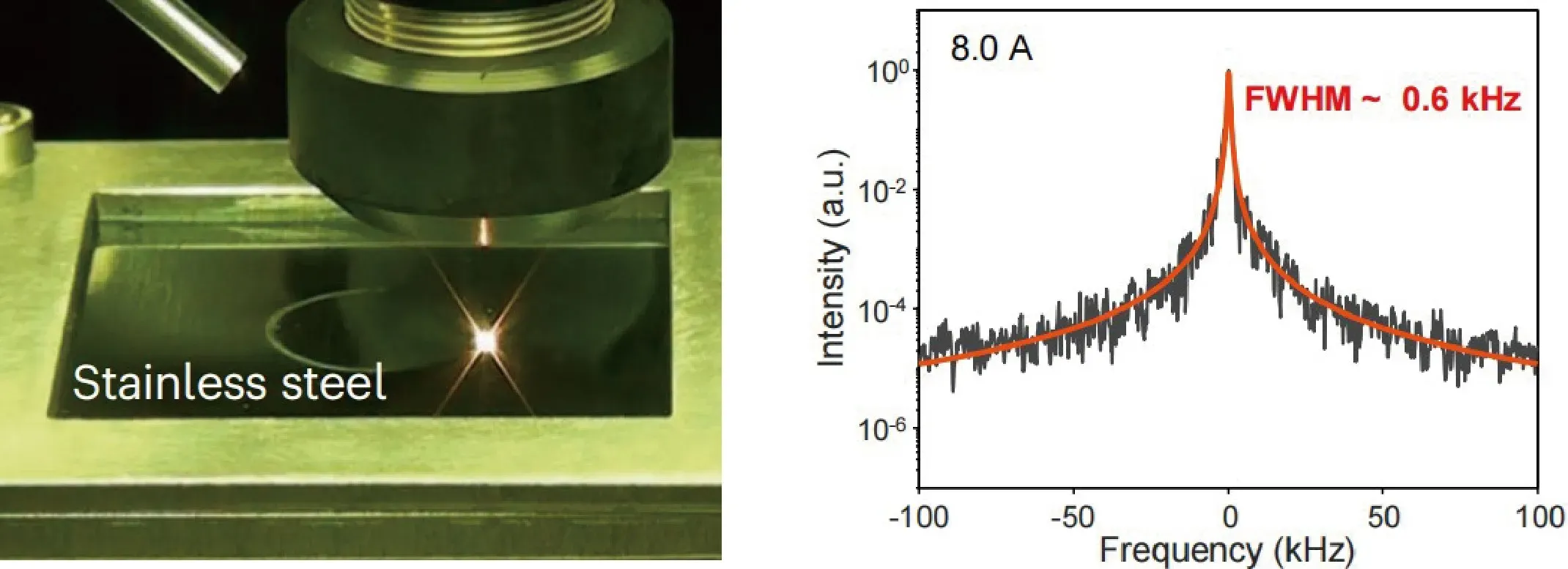
PCSEL performance: (a) compact metal processing (b) sub-kHz linewidth
Beam Shaping
By tailoring the position and size of air holes, PCSELs can directly control the emitted field and output direction. They can achieve ultra-small divergence without external collimation. With inverse design, PCSELs can emit complex beam profiles, effectively integrating diffractive optics into the cavity. Buried photonic crystal structures also enable integration with metalens processes for advanced beam control.
A Versatile “All-Rounder”
Since their invention in 1999, PCSELs have expanded from the near-infrared into other wavelengths. On the short-wavelength side, watt-level blue output (~430 nm) has been achieved with GaN. On the long-wavelength side, mid-infrared emission has been demonstrated, including multi-watt output in combination with quantum cascade lasers. Thanks to large photon numbers in the lasing mode, PCSEL linewidths can reach the kHz regime—far narrower than MHz-class DFB lasers—while maintaining high output power. High-peak-power nanosecond pulses can be generated by large pulsed injection, and direct high-speed modulation enables more compact optical communication systems without optical amplifiers.
As PCSEL performance continues to improve and micro/nanofabrication matures, large-scale production and commercialization are becoming feasible, opening new application opportunities. Over two decades, PCSELs have evolved from a laboratory concept to a technology with disruptive potential. Challenges remain—such as scaling single-mode device size for kilowatt-class continuous-wave power and achieving high performance across more material systems and wavelengths—but PCSELs are poised to play a major role in quantum technologies, space communications, laser fusion, and beyond.
Need full specs and pricing?
Contact our engineering team for datasheets and application support.